Is the metaverse dead? An honest 2026 status report.
The hype died. The platforms did not. What people read as a category collapse was the death of one word, two crypto bets, and a Meta product strategy that quietly turned mobile.
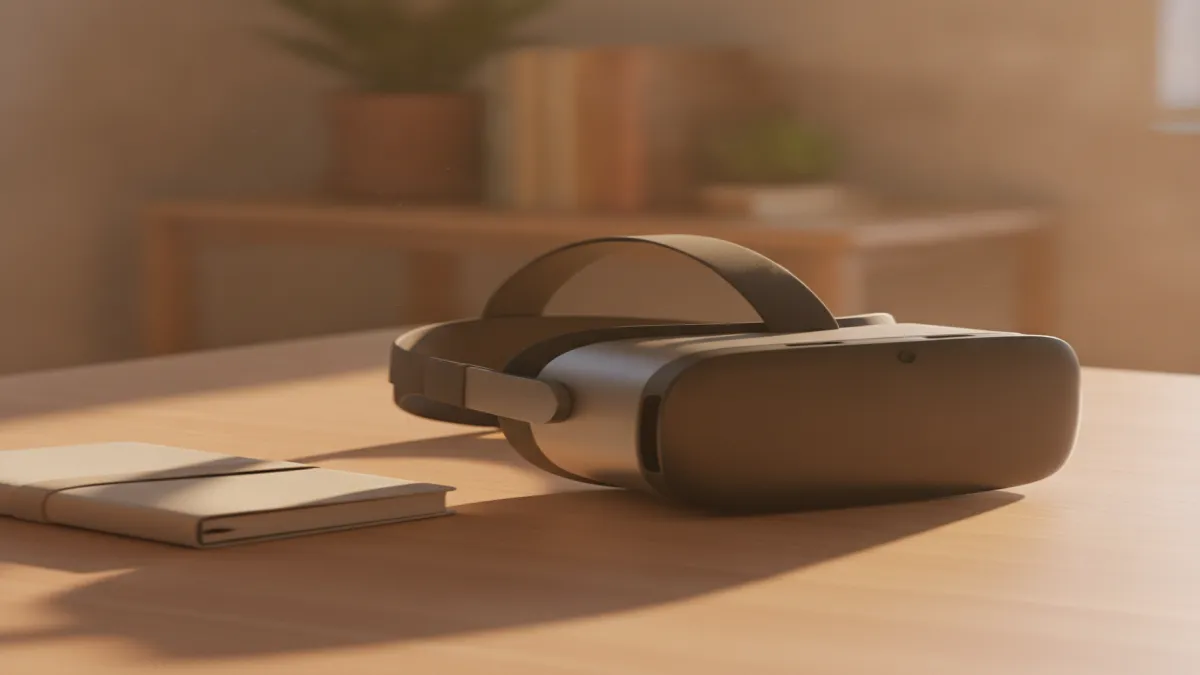
Short answer: No. The word "metaverse" has lost most of its meaning, but the platforms underneath have not. Roblox has 85.3 million daily users (Roblox, February 2025). VRChat hit a 156,700 concurrent peak on 15 February 2026. Decentraland just launched on Epic Games Store and Google Play. Meta is still spending, just no longer on VR-first product. The hype died. Living virtual worlds did not.
The hype crash, briefly
The peak was the autumn of 2021 and 2022. Facebook renamed itself Meta. JPMorgan opened a branch in Decentraland. Nike bought a virtual sneaker company. Goldman Sachs estimated the metaverse opportunity at trillions. None of those claims aged well.
By late 2022 the picture had already turned. DappRadar reported Decentraland with as few as 38 daily active wallet users (DappRadar, October 2022). The Sandbox, despite a token market capitalisation above one billion dollars, drew daily user counts in the hundreds. The Wall Street Journal reported that Meta Horizon Worlds had fewer than 200,000 monthly users, against an internal target of 500,000 by the end of 2022 (WSJ, October 2022).
Two things compounded the slide. Generative AI absorbed the public imagination and most of the venture capital from late 2022 onward. And the crypto-metaverse association became a liability rather than a draw, as token prices collapsed and headlines about empty virtual cities became standard. The word "metaverse" itself started showing up less in earnings calls.
What survived, with the numbers
This is the part the obituaries skipped. The platforms that did not depend on the word "metaverse" for their identity kept growing.
Roblox
Roblox Growing reported 85.3 million daily active users in February 2025 (Roblox, vendor disclosure). In the United States the platform's audience reportedly includes roughly half of all children under sixteen. In April 2026 Roblox launched on PlayStation 5, extending an already wide device footprint that already covered PC, Mac, iOS, Android, Xbox One, PlayStation 4, and Meta Quest 2 and Pro. None of this looks like dying.
VRChat
VRChat Growing set a record 156,700 concurrent users on 15 February 2026, driven by the Sanrio VFes anime concert premiere (Wikipedia, VRChat). The platform recorded roughly 120,000 concurrent users as a regular weekend baseline in 2025. The mobile app launched on 24 October 2025, opening a phone-first path into what had been a VR-and-PC platform. Adult content filtering was added in September 2023 and age verification through Persona arrived in January 2025.
Fortnite
Epic positions Fortnite Growing as a metaverse via UEFN, the in-game creator suite. The platform returned to the United States App Store on 20 May 2025 and runs across PC, Mac, PlayStation, Xbox, Switch, Switch 2, iOS, Android, and cloud streaming. Concurrent player records during concerts and event finales regularly cross ten million. Most of those users would never call what they are doing "the metaverse", which is exactly the point.
Minecraft
Minecraft Growing passed 350 million copies sold by 2023 (Mojang and Microsoft). Its server economy, education program, and creator community remain the original blueprint for what the word "metaverse" later tried to describe. PlayStation VR support was discontinued in March 2025, but the rest of the platform is healthier than ever.
What pivoted
Two of the most familiar metaverse names did something more interesting than die. They changed strategy.
Decentraland
On 31 March 2026 Decentraland Pivoting launched on Epic Games Store and Google Play for Android, with iOS to follow (GlobeNewswire press release, 31 March 2026; TheNextWeb, March 2026). For the first time since launch, a user could open the platform without ever touching a crypto wallet. The platform reported roughly 847,000 monthly unique web visitors in late 2025 and a 23 percent increase in daily unique visitors since mid-2025. In January 2026 it hosted 312 community events with an average attendance of 127 unique visitors each. Modest by mainstream gaming standards. Notable for a platform that survived the metaverse winter.
Meta Horizon Worlds
The headline pivot of 2026 was Meta itself. Horizon Worlds Pivoting announced in March 2026 that existing VR games would continue to run but no new VR games would be added. Meta said it would separate Worlds from the VR Quest platform and focus "almost exclusively" on the mobile version (Wikipedia, Horizon Worlds). In October 2024 the platform had also opened to a 10+ age group, where it had previously been 18+. The shift is consistent with the broader Meta strategy: Reality Labs continued to lose money at scale (around $19.1 billion in 2025 fiscal year, $80 billion cumulative through January 2026), and consumer adoption of standalone VR for social use never reached the curve Meta had projected.
What actually died
Quietly, and recently, two notable closures.
Rec Room
Rec Room Closed Jun 1, 2026 announced its closure on 30 March 2026 and shut its services on 1 June 2026 at 12:00 PT. The platform had been operating for nine years and reported a lifetime total of 150 million players across Quest, PC, PlayStation VR, PlayStation 4 and 5, Xbox One and Series X/S, Nintendo Switch, iOS and Android. Rec Room was free, contained no crypto, and was widely cited in the social VR conversation. Its closure is the cleanest single signal of the 2026 contraction in mid-tier social VR, and the largest user base any "metaverse" platform has formally taken offline.
If you came here looking for Rec Room, the closest social replacements are VRChat for the same VR social texture, Spatial for casual cross-device hangouts, and Fortnite Creative for casual mini-games with friends.
Sansar
Linden Lab's Sansar Closed , the VR-first follow-up to Second Life, never recovered after a peak of around 700 concurrent users in 2018 (Steam Charts historical) and was discontinued. Its closure was earlier and less noticed than Rec Room's, but it belongs in the same row of the ledger.
Where the money and the framing went
The argument that "the metaverse is dead" really lives in two places: in the change of label, and in where venture capital pointed instead.
Apple's launch of Vision Pro in 2024 introduced "spatial computing" as a deliberate alternative framing. Apple has not used the word "metaverse" in any product material. Vision Pro itself sold roughly 200,000 units in the two-week pre-order window in January 2024 (analyst estimates, MacRumors and Kuo); Apple has not disclosed official sales totals through 2026. Meta, even while losing tens of billions a year on Reality Labs, has shifted to talk about "AI glasses" and a mobile-first Horizon rather than the consumer VR metaverse it described in 2021.
On the funding side, generative AI absorbed the storytelling and the dollars from late 2022 onward. The metaverse listings on tech blogs were quietly replaced with "AI agents" and "Apple Vision Pro accessories".
The verdict
The metaverse is not dead. It is split.
Read this clearly: there are five platforms in the mainstream living layer with verified, large user bases, growing across phones, consoles, PC, and Quest. There are three platforms in the web3 layer that are pivoting away from wallet-only access toward mainstream distribution. There are four platforms in the spatial-rebrand layer where Apple's framing has taken over from Meta's. And there are two platforms in the closed shelf.
The 2021 promise of one continuous shared 3D internet that everyone joined through a Meta headset did not happen. The 2026 reality is messier, smaller in places, and bigger in others. If you came in asking whether to dust off a metaverse plan for a brand or a personal weekend, the answer is the same: tell us your device, your goal, and your age, and our matcher will return one to three real platforms that actually fit, with the verification dates on each.
Frequently asked about the metaverse and 2026
When did the metaverse die?
It did not. The hype died in 2022, when the Meta rebrand stalled and DappRadar reported Decentraland with as few as 38 daily active wallet users (DappRadar, October 2022). What people call "the death" was the collapse of a single framing, not the platforms themselves.
Did Meta abandon the metaverse?
No, but it pivoted. Meta Reality Labs has accumulated approximately $80 billion in cumulative operating losses through January 2026 (Reality Labs disclosures). In March 2026 Meta announced it would stop adding new VR games to Horizon Worlds and refocus on mobile-first.
Is Decentraland dead?
It is pivoting, not dead. On 31 March 2026 Decentraland launched on Epic Games Store and Google Play for Android (GlobeNewswire, March 2026), with iOS to follow. Web client traffic in late 2025 was roughly 847,000 monthly unique visitors (TheNextWeb, 2026).
Is The Sandbox dead?
It is in measurable decline. Engagement reporting in 2022 showed daily users in the hundreds despite a multi-billion-dollar token market cap. The platform still operates and still sells land, but third-party engagement signals have not recovered.
Are people still using VR?
Yes, just under different framing. VRChat hit a record 156,700 concurrent users on 15 February 2026 during the Sanrio VFes premiere (Wikipedia, VRChat). Most growth is now described as "VR gaming" or "spatial computing", not as "the metaverse".